

George helped me take my career to the next level despite struggling with ADHD and prioritizing effectively. Through our sessions, George understood the challenges specific to ADHD and provided both tangible and intangible tools to solve my problems.
Executive ADHD coaching
You've fixed the systems. Your own brain still hijacks the meeting.
One-on-one coaching for senior leaders with ADHD who don't need another productivity system—they need their own brain to stop running the meeting.
I've been there, too.
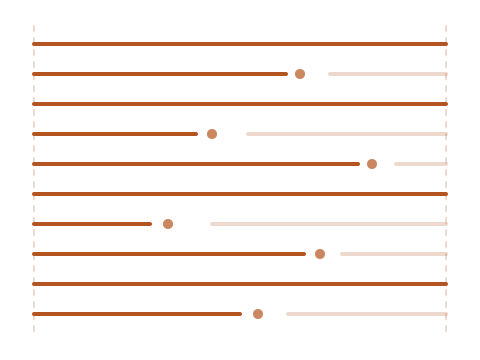
Some days it's rocket fuel. Some days it's sand in the gears.
You've built the org, shipped the roadmap, earned the seat—and on your best days your ADHD is exactly why. But the same wiring that gives you those days runs ahead of your judgment on the hard ones: you snap at a peer, over-commit, make the call you'd take back an hour later. The problem was never the variance. It's that there's nothing regulating the swing.
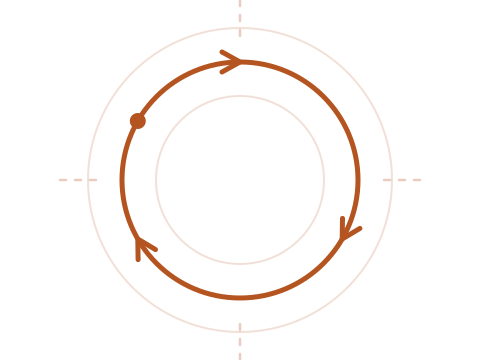
You can't discipline your way out of a wiring problem.
You've tried a million systems, and some even worked—for a while. Then the same loop closes again, and you promise yourself you'll handle it better next time. It keeps failing because organization was never the issue. The gap is regulation: the two-second window between what happens and what you do about it. At your level, that window costs peer relationships, hires, decisions you can't take back.
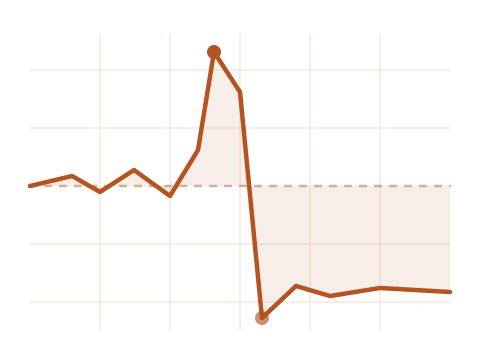
The superpower days and the crash are the same system.
Hyperfocus feels like a high—until you burn out, and what you built during the spike falls apart in the crash. The peaks and the valleys aren't two problems; they're one dial with no hand on it. Regulation isn't about flattening you into someone average. It's about keeping the good days without paying for them in the bad ones.
One of my clients—a VP of Engineering—had cried in front of his founders twice and yelled at his CTO. Two months into this work, he'd renegotiated his own role and taken on more. He didn't cope his way out. He changed the situation.
What changes when your hand's on the dial
Feel proud of the team you've built, and every member bringing their unique skills and perspectives.
Know that your team feels they can always count on your guidance, encouragement, and support.
Make a difference in the world with the strengths you actually have.
Distraction
Curiosity
Impulsiveness
Creativity
Hyperfocus
Superhuman energy
What's included
Every engagement
- $1,800–$3,000 a month—most reach their initial goals in three to four months, many continue longer
- 1-on-1 coaching sessions over Zoom
- Session recordings and transcripts
- Asynchronous support and accountability check-ins between sessions
- Practices to do on your own
- Resource library of tools, templates, and worksheets
Additional support
- Comprehensive assessment to identify strengths, growth areas, and patterns
- Strengths-based development plan, updated quarterly
- Goal-setting frameworks with measurable outcomes and timelines
- Emotional regulation strategies personalized to your challenges
What my clients are saying
My work with George has been truly transformative for me as a leader in my organization, and for my own career trajectory in general.
George has been instrumental in helping me find my voice as an executive. I'd recommend him to anyone who feels they need a trusted advisor to help them navigate a leadership role.
I reached out seeking clarity about what's next for me in my career, but what I received was a lot more in return. I discovered a safe space to express myself and make sense of how my experiences have shaped my choices.
I am truly grateful for the opportunity to work with you. I have learned a lot from you and gained a new perspective through your gentle but firm coaching and guidance.
George is good at observing people and assessing what they may need to move forward without telling them directly what to do.
Questions
Who is this coaching for, specifically?
Senior tech leaders with ADHD. VPs, directors, CTOs, founders—people who can actually shape the environment they work in. If you're senior, capable, and somehow still the bottleneck on your own team, that's the pattern I work with. If you're an individual contributor with no authority to change how your work happens, this probably isn't the right fit.
Can someone with ADHD actually be a great leader?
Yes. Some of the best leaders I've worked with—and worked under—have ADHD. The traits that get pathologized in regular jobs (pattern recognition, hyperfocus, willingness to make decisions under uncertainty, refusing to do things the boring way) are the same traits that build great companies. The problem isn't ADHD. The problem is trying to run an ADHD brain on neurotypical operating instructions.
What makes ADHD coaching different?
An ADHD coach is more directive than a regular coach. Traditional coaching is mostly Socratic—the coach asks questions, the client finds answers. That model assumes the client can reliably follow through on what they figure out. ADHD coaching adds active support: helping you build systems, then helping you actually use them between sessions. Not doing the work for you—doing it alongside you until the system sticks. For ADHD brains, that's not a luxury. It's what makes it work.
How is ADHD coaching different from therapy?
Different jobs. A therapist helps you process trauma, manage mood, or address clinical issues. A therapist frequently diagnoses a problem and prescribes a solution.
An ADHD coach helps you build the skills, systems, and self-knowledge to lead differently. Many of my clients see both. The work complements each other—it doesn't compete.
Do I need a formal ADHD diagnosis to work with you?
No. A formal diagnosis can be useful, but it's not required. Plenty of my clients came to me suspecting ADHD before they had it confirmed. Some still don't have a formal diagnosis and never will. What matters is whether the pattern fits—and whether you're ready to do the work.
Why do productivity systems keep failing me?
Because most of them were built for brains that don't have ADHD. GTD, time-blocking, every app on the App Store—they assume consistent motivation, reliable working memory, and tolerance for routine. ADHD brains don't run on those rails. You don't need a better system. You need a system designed around how your brain actually works.
Why do so many ADHD leaders burn out?
Because they succeed by working harder than everyone else. ADHD leaders compensate for uneven executive function with sheer effort—extra hours, masking, holding too much in their head, refusing to delegate because no one else does it "right." That works until it doesn't. Burnout isn't a failure of resilience. It's the math finally catching up.
What if I've already read every ADHD book and tried every system?
Most of my clients have. They show up smart, well-read, and frustrated that knowing isn't the same as doing. That gap is the actual work. Coaching isn't about teaching you new information. It's about turning what you already know into how you actually live and lead.
Will I still need my therapist or my medication?
Probably, yes. I'm not a therapist, a psychiatrist, or a prescriber. If you're seeing a therapist or taking medication, keep doing that. Coaching works alongside clinical care—not instead of it. If you need more clinical support than you're getting, I'll say so.
What if I've tried coaching before and it didn't work?
I hear this a lot—usually from people more disappointed in themselves than in the coach. Here's the truth: you'll still have to do the work. I can't predict or guarantee outcomes for you. What I can do is run an active, directive process—which the research shows works better for ADHD than traditional coaching. And I can promise this: I won't think less of you on the weeks when you struggle. That's not the bar.
What happens in a typical engagement?
The first few sessions are about figuring out what we're actually working on—the real thing underneath the surface complaint. From there, the work moves between two layers: tactical (systems, habits, communication, delegation) and substantive (values, identity, emotional regulation). We start with weekly sessions over Zoom, plus async support between. As you build momentum, we often shift to biweekly or monthly—whatever fits where you are in the work. Every quarter, we step back: what's shifted, what's next, what's no longer the goal. It's not a course. It's a working relationship.
How long does this take to work?
Most engagements run 6 to 9 sessions, usually over a few months. That's typically enough to work through whatever brought you in—the crisis, the crossroads, the pattern you couldn't break on your own. After that, many clients stay on. Not because the work is unfinished, but because once the urgent thing is handled, deeper work becomes possible: how you actually want to lead, what kind of life you're building, what's next. Some clients stay for a season. Some for years. You'll know when you're done.
What is the purpose of the introductory conversation?
Our introductory conversation will be approximately 45 minutes. And in the first 20–30 minutes, we'll discuss your challenges, goals, and what you hope to achieve with my support. This portion of the call will also allow you to experience my coaching style and decide if there's a good fit between your needs and my approach.
If we both feel a strong fit, the last 20 minutes cover how the program works, what's included, and what it costs. No pressure either way.
Will there be any obligation to make a purchase after the introductory conversation?
No. The intro call is a no-pressure conversation about your situation and whether coaching can help. If it's a fit at the end, we'll talk about next steps—but you're under no obligation. My practice isn't for everyone. I'd rather you make an informed decision than feel pushed.
How soon can I start coaching after signing up?
After you've been accepted into the program, your contract starts on the day I receive the first payment. You'll be able to schedule your first coaching session at that time.
Can I record my coaching sessions?
To help us stay 100% present during the call and not worry about taking detailed notes, I record and transcribe all our sessions with your consent.
Can I bring a business partner or team member to a session?
One-on-one sessions are strictly for you. You're welcome to share recordings and transcripts with partners or your team. If you'd like to bring others into the actual coaching, email sales@unleashyouradhd.com about group coaching.
What if I need to skip sessions for vacation or travel?
Life happens—vacations, illness, work crunches. We'll work around it. That said: if you're at a point where you can't carve out any real time for the work, this probably isn't the right moment. Come back when you're ready.
Is there a minimum commitment?
No. Coaching is a simple month-to-month subscription. You can cancel any time before your next billing cycle, and your sessions continue through the end of the current one. No long contracts, no minimum number of sessions, no penalties for stopping. If it stops being the right fit, you walk.
What's your refund policy?
The intro call is free, no obligation. If you join the program and aren't happy after your first week—for any reason—I'll refund you in full. After that, you can cancel any time before your next billing cycle. Your sessions continue through the end of the current cycle.
How do I pay you?
After you're accepted into the program, I'll send you a payment link. Billing runs through Stripe. I accept major credit cards, Apple Pay, Google Pay, ACH direct debit, and more.
Can I use my FSA or HSA to pay for coaching?
Possibly, with a Letter of Medical Necessity. Coaching isn't eligible on its own, but if ADHD is why you're here, your doctor, psychiatrist or therapist can write a letter saying coaching is part of treating it. This route needs a diagnosis. I'll give you a template to take to them.
With an FSA, you submit the letter and my receipt to your plan administrator, and they decide. A no just means no reimbursement. If you want to know before we start, ask them.
With an HSA, nobody checks at the time—you answer for it if you're audited. Get the letter before you pay and keep it with your receipts. No letter, no HSA.
FSA cards often decline for coaching, so pay with your regular card and claim it back. I'm not a tax advisor; if you're unsure, ask yours.